Save big on backing tracks today!

Virtual Pedalboard vs Real Pedalboard — Which Is Better for Guitar Practice?
In this guide, we'll compare virtual pedalboards and real pedalboards across every important dimension, so you can make the right choice for your playing and budget.
5/19/20264 min read
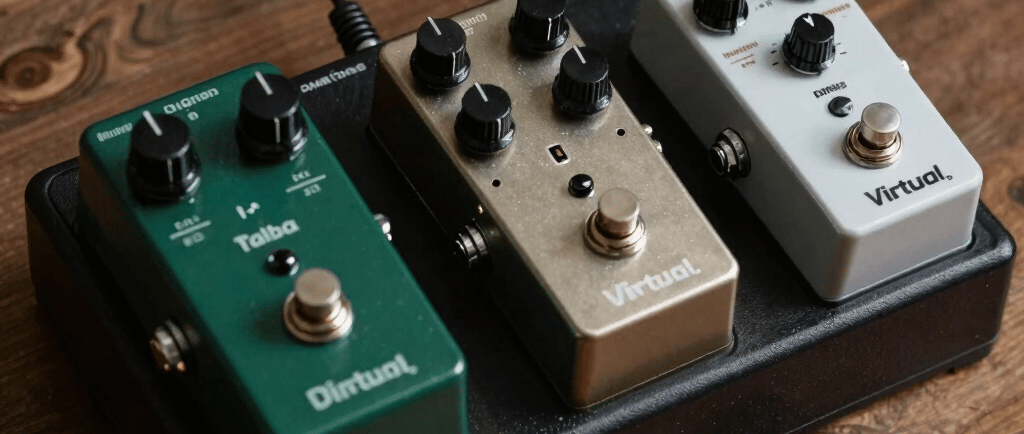
Every guitarist eventually faces the same question: should I invest in real pedals, or is a virtual pedalboard good enough? With online guitar effects tools getting better every year, the gap between virtual and hardware has never been smaller. But the two approaches still serve different purposes — and choosing the right one depends on what you actually need.
In this guide, we'll compare virtual pedalboards and real pedalboards across every important dimension, so you can make the right choice for your playing and budget.
---
## What Is a Virtual Pedalboard?
A virtual pedalboard is a software simulation of guitar effects — distortion, chorus, delay, reverb, EQ — that runs on a computer, phone, or tablet. Instead of physical pedals connected by cables, you adjust parameters on screen and hear the processed sound through your speakers or headphones.
Modern virtual pedalboards can run in a browser, as a dedicated app, or as plugins inside a DAW (Digital Audio Workstation).
## What Is a Real Pedalboard?
A real pedalboard is a physical collection of effects pedals arranged on a board and connected in a signal chain with patch cables. Each pedal is a dedicated hardware unit that processes your guitar signal electronically.
Real pedalboards range from a single overdrive pedal on the floor to elaborate rigs with dozens of pedals costing thousands of euros.
---
## Virtual vs Real Pedalboard — The Comparison
### Sound Quality
Real pedalboard wins — for most guitarists and most situations.
Hardware pedals, especially analogue ones, have a warmth and character that comes from actual electronic components processing your signal. Many guitarists describe analogue effects as sounding more "alive" or "breathing" compared to digital simulations.
That said, modern virtual pedalboards have improved dramatically. For practice, recording at home, and some live situations, the difference is genuinely small — especially for beginners whose ears haven't yet been trained to hear the subtle differences.
Verdict: Real pedals sound better, but the difference matters less than most people think.
---
### Latency
Real pedalboard wins — by a large margin.
Latency is the delay between when you play a note and when you hear the processed sound. Hardware pedals process your signal almost instantaneously — effectively zero latency.
Virtual pedalboards introduce some latency because the signal has to be converted to digital, processed by software, and converted back to audio. With a good audio interface, this can be reduced to 5-10ms — barely perceptible. With a basic setup (laptop microphone, browser-based effects), latency can reach 30-50ms or more, which is noticeable when playing in real time.
Verdict: For live playing where latency matters, real pedals win clearly. For practice and recording, a good audio interface largely closes the gap.
---
### Cost
Virtual pedalboard wins — dramatically.
A real pedalboard with a distortion, chorus, delay, and reverb pedal from reputable brands will cost at minimum €200-400. A quality professional setup can easily reach €1,000-3,000.
A virtual pedalboard can cost absolutely nothing. Browser-based tools like our Jam Tool give you all the essential effects for free. Even professional software like Guitar Rig or Amplitube costs €50-150 — a fraction of equivalent hardware.
Verdict: Virtual pedalboards are dramatically more affordable, especially for beginners.
---
### Portability
Virtual pedalboard wins — if you have a phone or laptop.
Carrying a real pedalboard to rehearsals, gigs, and travel is a real logistical challenge. Even a small board with 4-5 pedals weighs several kilograms and requires careful packing.
A virtual pedalboard goes wherever your phone or laptop goes. Our browser-based Jam Tool works on iPhone and iPad — your entire effects rig fits in your pocket.
Verdict: Virtual wins for portability. Real pedals require physical transport.
---
### Ease of Use
Tie — depends on what you mean.
Real pedals are simple to use in the moment — stomp to activate, turn knobs to adjust. There's a tactile, physical satisfaction to using hardware that many guitarists love.
Virtual pedalboards offer more complex routing options and the ability to save presets, but require more setup and can feel less intuitive for guitarists who prefer a physical workflow.
Verdict: Real pedals are more intuitive for beginners. Virtual offers more flexibility once you learn the software.
---
### Variety of Effects
Virtual pedalboard wins — by a huge margin.
A real pedalboard is limited by your budget and physical space. A virtual pedalboard can contain hundreds of different effects, amp simulations, and signal processing tools — all within the same software.
Verdict: Virtual wins for variety.
---
### Live Performance
Real pedalboard wins — for professional live use.
For gigging musicians, hardware reliability is essential. Real pedals don't crash, don't need a computer to function, and respond instantly to foot switches. Most professional guitarists use hardware pedals live, even if they use software for recording.
Verdict: For live performance, real pedals are more reliable.
---
## When to Choose a Virtual Pedalboard
A virtual pedalboard is the right choice when you:
- Are just starting out and want to explore different sounds without spending money
- Practice primarily at home
- Want to record guitar directly into your computer
- Travel frequently and need a portable solution
- Want to try before you buy — test which effects you use before investing in hardware
---
## When to Choose a Real Pedalboard
A real pedalboard is the right choice when you:
- Perform live regularly
- Have developed specific preferences and know exactly which effects you want
- Value the tactile experience of real hardware
- Are willing to invest in your sound long-term
- Work in recording situations where maximum sound quality matters
---
## The Best of Both Worlds
Many guitarists use both — a virtual pedalboard for practice and recording at home, and a real pedalboard for live performance. This approach gives you the flexibility of software for everyday use and the reliability of hardware when it counts.
---
## Try Our Free Virtual Pedalboard
At BackingTracksVerse, our free Jam Tool includes a complete virtual pedalboard with EQ, distortion (DS-1 style), chorus, delay, and reverb — all controllable with virtual knobs directly in your browser. No download, no account required.
👉 [Open the Jam Tool](https://pigmeu26-svg.github.io/Studio/) and start experimenting with guitar effects today — free on desktop, iPhone and iPad.
---
## Final Thoughts
Neither virtual nor real pedalboards are objectively better — they serve different purposes. For beginners and home practice players, a virtual pedalboard is an excellent starting point that costs nothing and sounds great. For live performers and experienced guitarists with specific tonal requirements, real hardware pedals remain the gold standard.
Start virtual, develop your ear, discover which sounds you love — then invest in hardware when you know exactly what you need.
---
Explore guitar effects with our free [online virtual pedalboard](https://pigmeu26-svg.github.io/Studio/). Practice with our [professional guitar backing tracks](https://backingtracksverse.com/shop) in every style.
Brand
Explore our sleek website template for seamless navigation.
Contact
Newsletter
© 2024. All rights reserved.