Save big on backing tracks today!

Line 6 POD Go Review
Helix Tones Without the Helix Price Tag
6/1/20267 min read
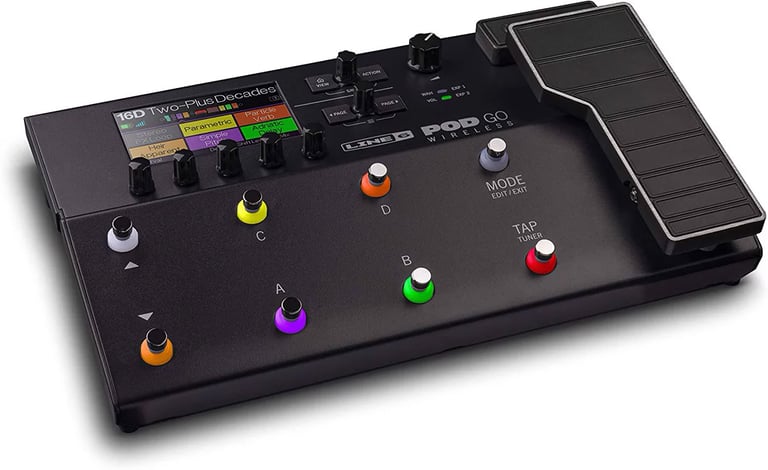
In 1998, Line 6 changed guitar playing forever with the original POD — a kidney-shaped desktop unit that put dozens of amp models in a box for the first time and made professional tone accessible to everyone. Over the following two decades, Line 6 built on that legacy with increasingly sophisticated systems, culminating in the Helix series — widely regarded as the gold standard of professional guitar modelling. Then, in 2020, they did something unexpected: they took the HX processing engine that powers the Helix, stripped away some of the routing complexity, added a built-in expression pedal and eight footswitches, and sold the result for a fraction of the Helix price. That unit is the POD Go.
Five years later, it remains one of the most recommended multi-effects processors on the market. Not because it's perfect — it isn't. But because what it does, it does with a level of quality that players spending twice or three times as much are only beginning to match.
Overall rating: 4.6 / 5 ★★★★½ Tone / Sound: 4.8 · Versatility: 4.7 · Ease of Use: 4.6 · I/O & Connectivity: 4.5 · Value for Money: 4.7
👉 Check the Line 6 POD Go price on Amazon
What Is the Line 6 POD Go?
The POD Go is Line 6's mid-range floor multi-effects processor — positioned between the compact budget units like the Boss GT-1 and Valeton GP-5, and the full professional Helix floor unit. It runs the HX processing engine — the same core technology as the Helix — giving you access to over 270 amp models and effects drawn from Line 6's entire modelling library, including the Legacy collection of classic Line 6 models going back decades.
The unit features a 4.3-inch full-colour LCD display, eight footswitches, a built-in expression pedal, stereo FX loop, MIDI control, a USB audio interface, and support for unlimited third-party IR loading. It ships with 256 presets — 128 factory and 128 user slots — and connects to the free POD Go Edit software on Mac and Windows for deep patch editing from your computer.
Users consistently note that the POD Go is equipped with the same tone as the Helix but in a more compact format — and that comparison holds up under scrutiny. Guitar Pedal X
Technical Specifications
Processing engine: HX (same as Line 6 Helix)
Amp models: 67 amp models + 194 effects from HX and Legacy libraries
Total effects & amps: 270+
Presets: 256 (128 factory + 128 user)
Simultaneous effects blocks: Up to 8 per patch
Snapshots: Yes (8 per preset — instant scene switching)
Built-in expression pedal: Yes (fully assignable)
External expression/footswitch: 2 additional inputs
FX loop: Stereo (send + return)
IR loading: Unlimited third-party IRs (WAV format)
Looper: 40 seconds mono / 20 seconds stereo (1-switch and 6-switch modes)
Display: 4.3" full-colour LCD
USB audio interface: Yes (24-bit recording)
MIDI: Yes (in/out via TRS)
Outputs: Main L/R (1/4"), Amp out (1/4"), Headphone (1/4")
Input: Guitar (1/4"), Aux in (1/8")
Tuner: Built-in chromatic with tap tempo
Software: POD Go Edit (free, Mac/Windows)
Weight: 2.49kg (POD Go) / 2.72kg (Wireless version)
The HX Engine — What Makes the POD Go Different
Every other unit in the budget and mid-range multi-effects category uses its own proprietary modelling technology — Boss's COSM, Hotone's CDCM HD, Mooer's MNRS. The POD Go uses HX. And HX is in a different league.
Like Line 6's Helix products, the POD Go provides state-of-the-art HX family sounds and powerful, convenient features including snapshots and IR loading. The HX engine models amplifiers not just by their sound but by their physical behaviour — how tubes saturate, how transformers respond under load, how different speakers interact with the amplifier's output stage. The result is modelling that doesn't just sound like a good approximation of an amplifier — it responds like one. Guitar practice gear
Once set up to taste, players consistently report forgetting they are playing through a modeller entirely and simply enjoying the inspiring tones at their disposal. That's the HX engine's quiet superpower: it doesn't just sound convincing in isolation, it sounds convincing while you're playing — responding to dynamics, volume knob adjustments and picking attack in the way that real amplifiers do. Alibaba
270+ Amps and Effects — A Career's Worth of Tone
The POD Go features 67 amp models and 207 effects drawn from Line 6's HX and Legacy libraries — covering everything from classic Fender and Marshall circuits to modern high-gain monsters, boutique clean platforms, vintage effects and contemporary studio processors. Line 6 has always prided itself on intuitive design and the POD Go is no different — the user experience is superb and editing is a breeze. AlibabaXTONES
The Snapshots feature — borrowed directly from the Helix — is one of the POD Go's most powerful live performance tools. Each preset can store up to 8 snapshots: instant states of the entire signal chain that can be recalled with a single footswitch press without any audio dropout. One snapshot for your clean tone, one for crunch, one for lead boost, one for ambient swell — all within the same preset, switching instantly. No other unit in this price range offers anything comparable.
The 40-second mono looper (20 seconds stereo) is also significantly more capable than what budget units offer, and the 1-switch and 6-switch looper modes give you flexibility for both simple practice loops and more complex live performance layering.
IR Loading — Unlimited and Unrestricted
Unlike units that limit you to 5, 20 or 50 IR slots, the POD Go supports unlimited third-party IR loading. You can build an entire library of cabinet impulse responses — from free community IRs to premium commercial collections — and access all of them through the POD Go Edit software. For players who have invested in quality IR libraries, this is a significant practical advantage over almost every competitor at this price point.
POD Go Edit — The Best Software in Its Class
POD Go lends itself to onstage use into the PA or in front of your amp, whether standalone or integrated into a larger pedal rig, and also has everything needed for home practice and recording, including a 24-bit audio interface. The POD Go Edit software on Mac and Windows makes all of this significantly more accessible, providing a visual drag-and-drop patch editor that displays your entire signal chain on screen, lets you swap blocks by clicking, adjust parameters with on-screen knobs and save everything with a single click. TalkBass.com
There are 128 user presets alongside 128 factory presets — a great place to start. The factory presets cover an impressive range of genres and playing styles, and the Line 6 Customtone community gives you access to thousands of additional user-created presets for free download. XTONES
Pros & Cons
What the POD Go gets right: HX processing engine delivering genuine Helix-quality tone at a significantly lower price, 270+ amps and effects from the complete HX and Legacy libraries, Snapshots for instant scene switching within presets, unlimited third-party IR loading, built-in expression pedal, 40-second looper, stereo FX loop for integrating analogue pedals, MIDI in/out, 24-bit USB audio interface, 4.3" full-colour LCD display, excellent POD Go Edit software, and 256 presets covering virtually every genre and playing style.
Where it falls short: heavier and larger than compact rivals at 2.49kg — not truly pocket-sized, signal chain is less flexible than the full Helix floor unit (fewer simultaneous blocks and routing options), no rechargeable battery (requires mains power), deeper editing benefits significantly from the computer software, and the price is considerably higher than budget compact units like the Valeton GP-5 or Boss GT-1.
How It Compares to the Competition
POD Go vs Boss GT-1
The GT-1 has battery operation, a lower price and decades of Boss reliability behind it. The POD Go counters with HX processing that sounds measurably better, Snapshots, unlimited IR loading, a stereo FX loop, MIDI and a significantly more capable looper. For players who have outgrown the GT-1 or want professional-quality tone for home recording and live performance, the POD Go is the obvious next step.
POD Go vs Hotone Ampero II Stomp
The closest comparison in terms of price and capability. The Ampero II Stomp has a touchscreen, 8-in/8-out USB audio and costs less. The POD Go counters with the HX engine — which sounds more refined and dynamically convincing than CDCM HD — Snapshots, a more established platform with a larger community and years of firmware development, and unlimited IR loading. Both are excellent units; the POD Go wins on tone quality and ecosystem maturity, the Ampero II Stomp wins on touchscreen usability and USB audio depth.
POD Go vs IK Multimedia TONEX One
Different philosophies entirely. The TONEX One wins on amp-tone authenticity through AI Machine Modeling. The POD Go wins on completeness — effects chains, Snapshots, looper, MIDI, FX loop and a full multi-effects system that the TONEX One cannot replicate. Many professional players use both units together: TONEX One for amp capture tone in the POD Go's FX loop.
POD Go vs Line 6 Helix Floor
The Helix Floor costs roughly three times as much and offers more simultaneous blocks, more flexible routing, more I/O and a larger display. The POD Go runs the same HX engine and sounds virtually identical in most playing contexts. For the vast majority of guitarists — including professionals — the POD Go covers everything the Helix does at a fraction of the price. The Helix is for players who need maximum routing complexity for the most demanding professional live rigs.
Who Is the POD Go For?
The POD Go is the right choice for serious guitarists who want professional-quality tone and refuse to compromise. It suits intermediate to advanced players who have outgrown budget compact processors and want something that will serve them credibly in home studio recording, rehearsal, live performance and practice for many years. It's ideal for players who want Helix-quality modelling without the Helix price, those who need Snapshots for seamless live switching between tones, and home studio players who want a complete multi-effects unit and USB audio interface in one professional package.
It's less suited for players on a tight budget who would be better served by the Valeton GP-5 or Boss GT-1, those who need battery-powered operation for outdoor or travel use, or players who want a truly pocket-sized unit for casual practice.
POD Go + Backing Tracks — The Professional Practice Rig
For the BackingTracksVerse community, the POD Go represents the top of the ladder for home practice rigs. Plug your guitar in, connect your headphones to the headphone output, feed a backing track from your phone through the AUX input, and you have Helix-quality amp modelling, a complete effects chain and your backing track all arriving in perfect balance through a single pair of headphones. The Snapshots feature means you can switch instantly from a clean jazz tone to a lead boost mid-song without touching anything except a footswitch — the same way a professional would do it on stage.
The 40-second looper means you can build full backing arrangements from scratch without any external track, and the USB audio interface lets you record everything directly into your DAW at 24-bit quality when you want to capture what you've been working on.
Final Verdict
The Line 6 POD Go is the best value proposition in professional-grade guitar modelling available today. Five years after its release, no competitor has managed to offer HX-quality processing at this price point — and the combination of 270+ amps and effects, Snapshots, unlimited IR loading, stereo FX loop, MIDI and a polished software editor makes it a genuinely professional tool that will serve you credibly in any context. If you are serious about your tone and ready to invest in something that will last for years, the POD Go is the unit to buy.
Rating: 4.6 / 5
👉 Buy the Line 6 POD Go on Amazon
Disclosure: This article contains affiliate links. If you make a purchase through our links, we earn a small commission at no extra cost to you. This helps us keep creating free content for the BackingTracksVerse community. Thank you for your support!
Brand
Explore our sleek website template for seamless navigation.
Contact
Newsletter
© 2024. All rights reserved.