Save big on backing tracks today!

How to Use Backing Tracks to Improve Your Guitar Improvisation
In this guide, we'll show you exactly how to use backing tracks to improve your guitar improvisation, step by step — from choosing the right track to developing advanced soloing techniques.
BackingTracks Verse
5/15/20264 min read

What Are Backing Tracks?
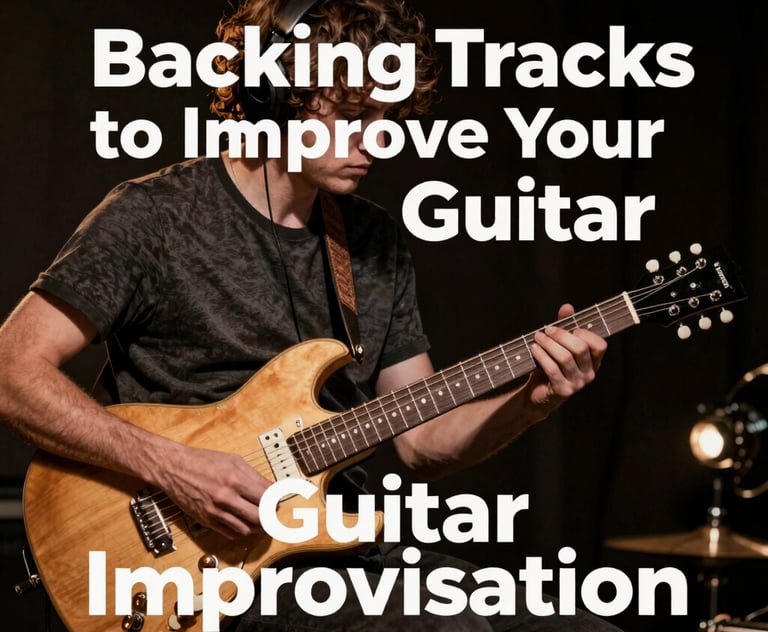
A backing track is a pre-recorded piece of music — drums, bass, chords, sometimes keys or horns — that you play along to as if you were the lead guitarist in a band. The lead guitar part is intentionally left out, giving you space to improvise and create your own melodies.
Think of a backing track as your personal band, available 24 hours a day, ready to play any style, any key, at any tempo.
---
Why Backing Tracks Are the Best Tool for Improvisation
Learning to improvise in isolation — just you and your guitar — is like learning to have a conversation by talking to yourself. You can practice the words, but without a real exchange, you never develop true fluency.
Backing tracks simulate a real musical conversation. They give you:
Harmonic context — You hear your notes against real chords, which trains your ear to understand which notes work and which don't.
Rhythmic pressure — The drums and bass keep moving whether you're ready or not. This builds timing and the ability to commit to musical phrases.
Style immersion — Playing over a blues backing track trains your blues phrasing. Playing over jazz changes trains your jazz vocabulary. You absorb style naturally.
Instant feedback — Every note you play is immediately evaluated by your ear against the harmony. There's nowhere to hide — and that's exactly what makes you improve faster.
---
Step-by-Step Guide to Improvising with Backing Tracks
Step 1: Choose the Right Key and Style
Start with a style you already enjoy listening to. If you love blues, start with a blues backing track. If you love rock, start there. Playing music you love keeps you motivated.
For the key, beginners should start with A minor or G major — both are guitar-friendly keys with comfortable scale positions.
Step 2: Learn the Scale First
Before you improvise, make sure you know the scale that works over the backing track.
- Blues backing track → A minor pentatonic scale
- Rock backing track → A minor pentatonic or A natural minor
- Jazz backing track → Dorian mode or the specific chord-based approach
- Major key backing track → Major pentatonic or major scale
Spend 5-10 minutes just running the scale up and down before you start improvising. Get it under your fingers.
Step 3: Start with One Note
This sounds too simple, but it works. Start the backing track and play just one note — the root note of the key. Hold it, bend it, let it ring. Listen to how it sounds against the chords.
Then try two notes. Then three. Build your phrases gradually rather than trying to play everything at once.
Step 4: Use Call and Response Phrasing
Great improvisers think in questions and answers. Play a short phrase (the question), then leave space (the answer). This creates musical conversations rather than a stream of notes.
A practical exercise: play for 2 bars, then be completely silent for 2 bars. Listen to the backing track during the silence. Then respond. Repeat.
Step 5: Focus on Rhythm Before Pitch
Many beginners focus on which notes to play and ignore how to play them. But rhythm is at least 50% of what makes a guitar solo sound great.
Practice playing just a single note with different rhythmic feels — long sustained notes, short punchy notes, syncopated rhythms. Notice how much the rhythm alone changes the emotional impact.
Step 6: Record Yourself
This is uncomfortable but essential. Record your improvisation sessions and listen back. You'll immediately hear things you can improve — rushing the tempo, overplaying, not leaving enough space, using the same licks repeatedly.
Recording doesn't lie, and it accelerates your development faster than almost anything else.
---
Advanced Backing Track Techniques
Once you're comfortable with the basics, try these more advanced approaches:
Target chord tones — Instead of just playing the scale randomly, aim for the root, third, or fifth of each chord as it changes. This makes your improvisation sound more intentional and musical.
Change positions — Practice the same scale in different positions on the neck. Being able to move freely across the fretboard opens up new melodic possibilities.
Use dynamics — Play softly for a few bars, then build to a loud, aggressive phrase. Dynamics — the variation between loud and quiet — are one of the hallmarks of a mature improviser.
Learn specific licks — Transcribe short phrases from your favourite guitar solos and incorporate them into your improvisations. This is how all the great guitarists learned.
Change tempo — Practice the same improvisation at slow tempo (60 BPM), medium tempo (90 BPM), and fast tempo (120 BPM). Each tempo reveals different challenges.
---
Choosing the Right Backing Tracks
Not all backing tracks are equal. For effective improvisation practice, look for tracks that:
- Are mixed at a professional level — drums, bass, and chords should sit well together
- Are in a clear key with consistent harmony — avoid tracks with too many complex chord changes when you're starting out
- Have the right tempo for your current level — start slow, build up
- Cover the style you want to develop
At BackingTracksVerse, our backing tracks are professionally produced for guitarists who want to practice improvisation seriously. Each track is designed to give you the best possible harmonic and rhythmic context for developing your playing.
👉 [Browse our backing track collection](https://backingtracksverse.com/shop) — available in blues, rock, jazz, pop, and more.
---
Combine Backing Tracks with Our Free Jam Tool
For even more flexibility, try combining professional backing tracks with our free Jam Tool — an online chord sequencer, drum machine, and virtual pedalboard that you can customise to create your own backing tracks in any key and style.
👉 [Open the Jam Tool](https://pigmeu26-svg.github.io/Studio/) — free, no download required.
---
How Long Before You See Results?
With consistent practice — even 20-30 minutes a day — most guitarists start hearing real improvement in their improvisation within 4-6 weeks of regular backing track practice. The key is consistency over intensity.
Practice a little every day rather than a long session once a week. Your brain and fingers need regular repetition to build new musical pathways.
---
Final Thoughts
Backing tracks are one of the most powerful tools available to any guitarist who wants to improve their improvisation. They give you the experience of playing with a band, the freedom to make mistakes, and the harmonic context to develop your musical ear.
Start simple, be patient with yourself, and enjoy the process. Every great improviser started exactly where you are now.
---
Start your improvisation journey today with our [professional guitar backing tracks](https://backingtracksverse.com/shop) and our free [online Jam Tool](https://pigmeu26-svg.github.io/Studio/).
Brand
Explore our sleek website template for seamless navigation.
Contact
Newsletter
© 2024. All rights reserved.