Save big on backing tracks today!

Boss GT-1 Review
The Legendary Multi-Effects That Refuses to Be Beaten
Backing tracks verse
5/25/20267 min read
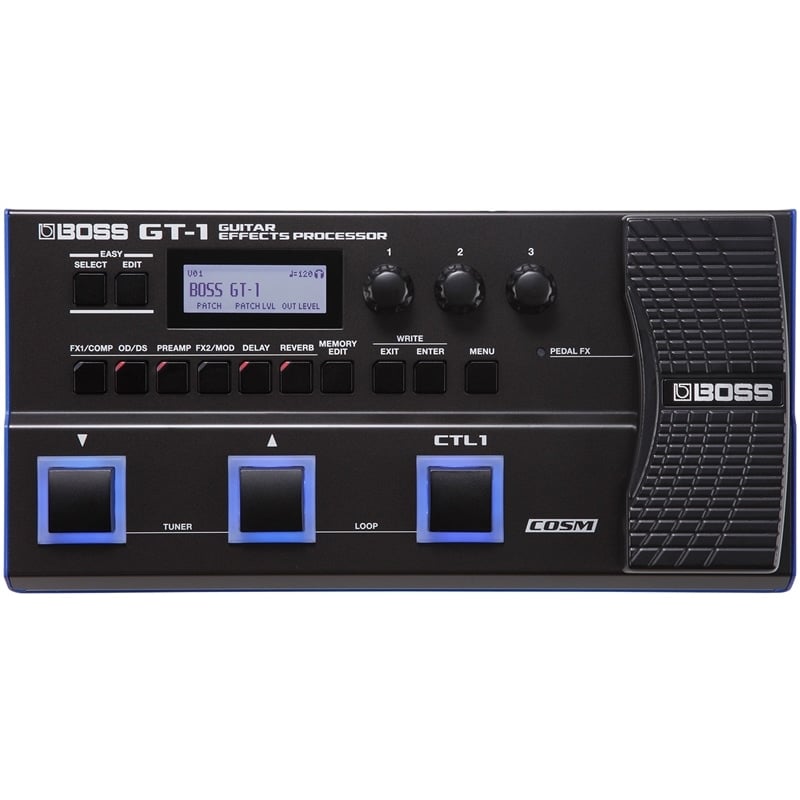
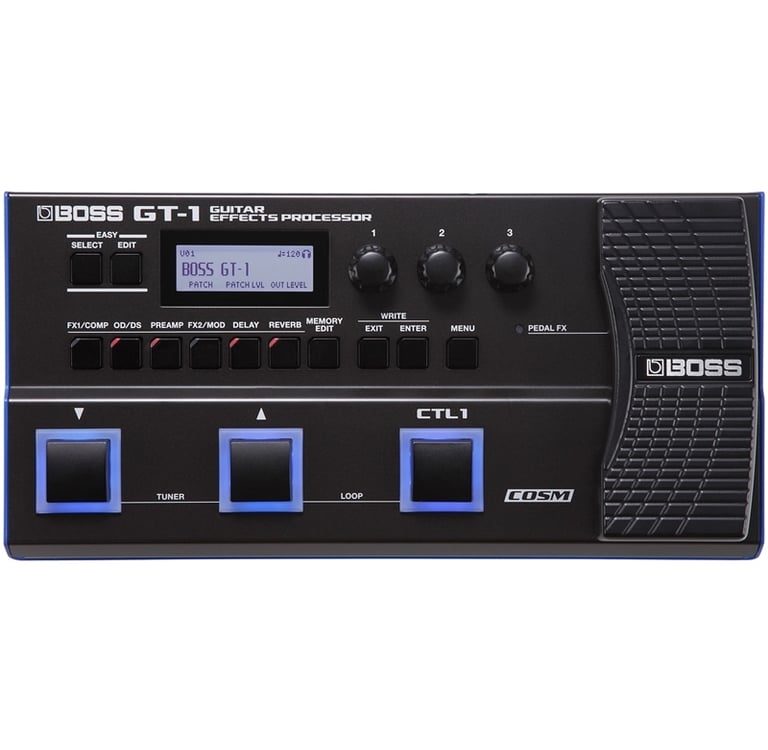
Some gear becomes a classic because it's fashionable. Some gear becomes a classic because it's genuinely, stubbornly, year-after-year excellent. The Boss GT-1 is firmly in the second category. Released in 2016 and still selling strongly in 2025, it has outlasted trends, survived the compact modeller explosion, and continues to sit comfortably on the shortlist of any guitarist looking for a reliable, great-sounding multi-effects unit without spending a fortune.
The reason is simple: Boss took the sound engine from their flagship GT-100 — a processor that costs twice as much — and stuffed it into a compact, battery-powered floor unit. The GT-1 isn't trying to be the flashiest pedal on the market. It's trying to be the most dependable. And after nearly a decade on the market, it has more than proved its case.
Overall rating: 4.3 / 5 ★★★★ Tone / Sound: 4.4 · Versatility: 4.5 · Portability: 4.3 · Ease of Use: 4.2 · Value for Money: 4.2
👉 Check the Boss GT-1 price on Amazon
What Is the Boss GT-1?
The GT-1 is Boss's entry-level floor multi-effects processor, designed to bring the quality and depth of their premium GT series to a wider audience at a more accessible price. It runs on four AA batteries (up to 7 hours), can be powered via USB, features a built-in expression/wah pedal, an LCD screen, stereo outputs, a headphone jack and a USB audio interface — all in a package that fits in a gig bag pocket.
At its core, it runs the same COSM (Composite Object Sound Modelling) technology that powers Boss's more expensive units — the same engine used in the GT-100. That means 108 effects drawn from Boss's entire catalogue, 27 amp and speaker simulations, 99 factory presets and 99 user patch slots. For a pedal at this price, that's a genuinely remarkable amount of processing power.
Technical Specifications
Sound engine: COSM (same as GT-100)
Total effects: 108
Amp/speaker simulations: 27
Factory presets: 99
User patches: 99
Simultaneous effects blocks: Up to 7 per patch
Built-in expression pedal: Yes (assignable: wah, volume, pitch, modulation speed and more)
External expression pedal inputs: 2 x footswitch/expression jack
Looper: 32 seconds (mono)
Tuner: Built-in chromatic
Display: Backlit LCD
Outputs: Dual stereo outputs (L/R)
Headphone output: Yes (3.5mm)
AUX input: Yes (3.5mm — for backing tracks or phone)
USB: Yes (audio interface + patch editor)
USB audio: 24-bit / 44.1kHz
Battery: 4 x AA (up to 7 hours)
Power: DC 9V adapter (optional)
Weight: 2.9 lb / 1.32kg
Dimensions: 13.5" x 5.8" x 2.2"
The COSM Engine — Boss's Crown Jewel
The most important thing to understand about the GT-1 is what's under the hood. COSM — Composite Object Sound Modelling — is Boss and Roland's proprietary modelling technology, developed over decades and refined continuously across their entire product line. It analyses amplifier circuits not just in isolation but as a complete interactive system, accounting for how components behave differently at various temperatures, power levels and signal strengths.
The COSM modelling technology employed by more premium Boss and Roland units is fully featured in the GT-1 — and it shows. Among the highlights are the HiGain Stack, modelled on a vintage Marshall, and the VO Drive, modelled on the overdrive channel of a Vox AC30. In testing, the amp models hold up exceptionally well. Clean tones have genuine body and sparkle. Crunch tones respond convincingly to picking dynamics. High-gain models retain definition even under heavy distortion — something cheaper digital units frequently struggle with.
The GT-1 features 108 effects running at a sample rate of 44.1kHz with 24-bit conversion. That's the same audio quality you'd expect from a dedicated recording interface, not a budget floor pedal.
108 Effects — Breadth Without Compromise
The GT-1 contains 99 preset and 99 user patches, each built from a chain of blocks that can draw from 108 effects, including 27 amp/speaker simulations and a 32-second looper. The effects library covers everything: overdrives, distortions, fuzzes, compressors, EQs, chorus, flanger, phaser, tremolo, pitch shifting, harmoniser, wah, delay, reverb, and beyond. Among the 22 overdrive and distortion types alone, the range should leave nothing to be desired for most players.
What sets the GT-1's effects apart from cheaper units is consistency. Every effect in the library sounds polished and musical — there are no throwaway algorithms included just to inflate the count. The reverbs are lush, the delays are clean, and the modulations have genuine depth and movement. Boss incorporated the sound engine from its more expensive devices into the GT-1, which is a definite plus — and the presets cover a wide range of genres and techniques.
The built-in expression pedal is one of the GT-1's most practical features. It controls everything from wah to volume to modulation speed and more, all without needing an external pedal. Two additional footswitch/expression pedal inputs let you expand the setup further if needed.
99 Presets — Ready to Play Immediately
The preset patches cover a wide range of different playing styles and genres — amateurs and intermediates will love them as-is, and intermediate-advanced players will love the customisation features for creating and saving new patches.
The factory presets are genuinely impressive for a unit at this price. From clean jazz tones to searing metal leads, from ambient soundscapes to acoustic simulations, the GT-1 ships ready to cover almost any genre immediately. If you don't feel like crafting your own tone recipes, the presets are aces. And for those who do want to go deeper, Boss's companion software gives you a visual patch editor on your computer and access to thousands of community-created patches available for download.
Pros & Cons
What the GT-1 gets right: the GT-100 sound engine at half the price, 108 effects with 27 amp simulations, 99 factory presets + 99 user slots, built-in expression/wah pedal, 32-second looper, battery operation (up to 7 hours on 4 AA batteries), AUX input for backing tracks, headphone output for silent practice, USB audio interface at 24-bit, stereo outputs, rock-solid Boss build quality and reliability, and one of the largest communities of patch-sharing users of any compact multi-effects unit.
Where it falls short: heavier than ultra-compact rivals at 1.32kg, no rechargeable battery or USB-C power (requires AA batteries or 9V adapter), no IR loading from third parties, no NAM support, no Bluetooth for wireless editing, and deeper patch editing benefits significantly from the companion software rather than on-device controls alone.
How It Compares to the Competition
GT-1 vs Valeton GP-5
The GP-5 is lighter, cheaper, supports NAM and has Bluetooth — all genuine advantages. The GT-1 counters with a built-in expression pedal, a 32-second looper, more user patches, a longer-established effects engine, the weight of Boss's reputation for reliability, and a community of thousands of patch creators. For working musicians who need something that will survive years of use without question, the GT-1's track record is unmatched. For tone explorers who want cutting-edge NAM technology and maximum portability, the GP-5 is the better tool.
GT-1 vs IK Multimedia TONEX One
Completely different philosophies. The TONEX One wins on amp-tone authenticity through AI Machine Modeling — if sounding exactly like a specific real amplifier is your goal, it's the better choice. The GT-1 wins on completeness: it has effects, a looper, an expression pedal, an AUX input and 108 effects that the TONEX One simply doesn't offer. For players who need a single unit to cover everything from practice to performance without any additional gear, the GT-1 is far more self-contained.
GT-1 vs M-VAVE Tank-G
The Tank-G has a built-in rechargeable battery and an XLR output, which are meaningful advantages. The GT-1's COSM engine sounds noticeably more refined than the Tank-G's modelling, its effects library is substantially deeper, and the built-in expression pedal adds real-time control that the Tank-G lacks. For players who prioritise tone quality and flexibility over absolute portability, the GT-1 is worth the extra investment.
Who Is the GT-1 For?
The GT-1 is the right call for guitarists who want a proven, complete, all-in-one rig that covers every situation — from bedroom practice to live performance — without compromise. It suits intermediate players who have outgrown simple processors and want access to a genuinely deep effects system. It's ideal for travelling musicians who need a compact, battery-powered option that doesn't ask them to sacrifice sound quality. And it's a natural choice for anyone who values Boss's legendary reliability above all else — if you need gear that will still work perfectly in ten years, Boss is the brand you buy.
It's less suited for players who want the latest NAM technology or Bluetooth wireless editing, those who need something ultra-lightweight at under 300g, or players on a very tight budget who can get most of what they need from a cheaper option like the Valeton GP-5.
GT-1 + Backing Tracks — The Complete Practice Partner
The GT-1 has a feature that makes it particularly brilliant for the BackingTracksVerse community: the AUX input. Plug your phone or computer directly into the GT-1 via the 3.5mm AUX jack, connect your headphones to the headphone output, and you have your guitar, your effects, your amp simulation and your backing track all mixed together in perfect balance — no separate mixer, no extra cables, no additional hardware. Everything comes out of the headphones in one clean, blended signal.
If you're a travelling musician with the need to keep gear to a minimum, the GT-1 represents a powerful and better-than-passable alternative to big pedalboards. Add a backing track into the mix and you have one of the most practical home practice rigs imaginable. The 32-second looper also means you can lay down a chord progression and solo over it when you don't have a track ready — a feature none of the ultra-compact rivals in this price range match.
Final Verdict
The Boss GT-1 is the definition of a safe bet. After nearly a decade on the market, it continues to be one of the most recommended multi-effects units for players who want serious quality without serious money. The COSM engine sounds superb, the effects library is vast and consistently musical, the expression pedal adds real-time control that most compact rivals lack, and the battery operation gives you genuine flexibility. Newer units may offer NAM, Bluetooth or lighter enclosures — but very few can match the GT-1's combination of tone quality, feature depth, build reliability and the sheer depth of its user community. This is a pedal that earns its place in any rig, and keeps earning it year after year.
Rating: 4.3 / 5
Disclosure: This article contains affiliate links. If you make a purchase through our links, we earn a small commission at no extra cost to you. This helps us keep creating free content for the BackingTracksVerse community. Thank you for your support!
Brand
Explore our sleek website template for seamless navigation.
Contact
Newsletter
© 2024. All rights reserved.